Cold Coffee
never breaking news.
This is not a pipewrench | Dada Sounds

“An original is a creation motivated by desire. Any reproduction of an originals motivated be necessity. It is marvelous that we are the only species that creates gratuitous forms. To create is divine, to reproduce is human.” - Man Ray
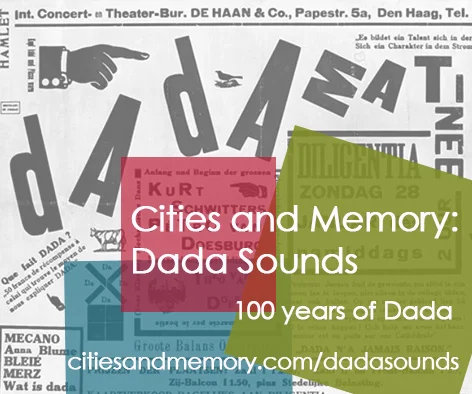
I contributed a piece to the Cities and Memory Dada Sounds project.
February 5, 2016 marks 100 years since the founding of the Cabaret Voltaire in Zurich, and thus the beginning of Dada.
To mark the occasion, Cities and Memory: Dada Sounds marks a century of Dadaism by applying the techniques and practices of Dada to field recordings from around the world, bringing a Dadaist approach to the concepts of sound, place and memory and creating a new, Dada-inspired sound world.
The whole amazing collection is here.
My contribution: Swiss MLK
My process as thus: I chose a recording from the Cities and Memory sounds that was made inSwitzerland because Dada. As I was working on it over the Martin Luther King holiday I worked in units of 1.18. I laid a grid over the source recording breaking it up in 1.18 second segments. I used a random number generator to rearrange the clips until I had a length of 1min, 18 seconds. I decided I wanted to collage in sound that related to the moment in time that I was working on this so I randomly recorded a German language news radio station coming out of Switzerland at the same time I was editing the first piece. I took that recording and applied the same method to chop it up. On both recordings I used a second set of randomly generated numbers to apply a small set of effects (backwards, reverb) to a few clips. As an homage to Man Ray I wanted to suggest an aural layer of dust, so I stretched out the edited version of the first track and then I mixed all three together in a very un-Dada deliberate way.
Viva la chance.
Cities and Memory Utopia Sounds Project

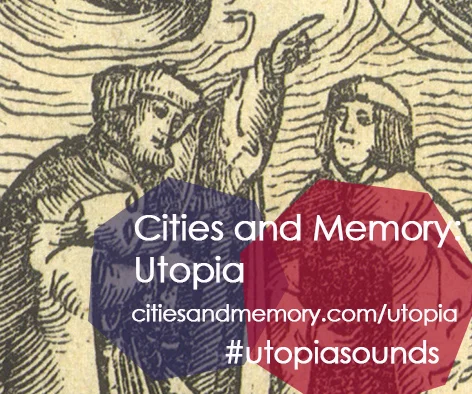
I created this sound piece for the Cities and Memory Utopia project. Inspired by the map above, or more specifically grid area A2.
I was drawn to this section by it's suggestion of a rocky coast and what may be a church or monastery clinging to a rugged cliff. I imagined the sounds of the sea and then I recalled an aural image of another mythological place, the sunken cathedral in the evocative prelude by Claude Debussy. In this piece, La cathédrale engloutie, Debussy creates an impression of the mythic cathedral as it rises momentarily from a clear morning sea, suggesting the peal of bells and the singing of the choir carried on the wind. This work is based on an ancient Breton legend of the Island of Ys.
In my piece I have taken up the thought that the church depicted in my corner of Utopia would someday suffer the same fate, and may perhaps be the very same place. I imagined it not yet sunken into the ocean, but still standing precariously high above the waves, alive with the sounds of religious service. The bells follow Debussy’s tonal progression, suggesting the future fate of the church.I imagine the listener standing outside, perhaps on the rocks below with the smell and the sound of the surf close by. In my own Utopia the most profound religious experience happens out of doors.This sound was constructed with my own field recordings of the Rhode Island coast and from recordings from the London Sound Survey. The snippet of the Debussy prelude is from a recording by Ruben Yessayan.

LITERATURE AND SOUND ART COMBINE AS ARTISTS IMAGINE THE SOUNDS OF THOMAS MORE’S UTOPIA
51 sound artists and musicians from across the world reimagine one of the greatest works of English literature, using sound.
The Cities and Memory: Utopia project creates something new from the words of Thomas More and the collective imagination of artists around the world – an entirely new Utopia of sound.
Using a woodcut map from the second edition of Utopia from 1518, sound artists each took a small section of More’s imagined country of Utopia, and created a new soundscape imagining how that place (and the society living in it) might sound.
The result is a collaborative sonic imagination of what More’s Utopia might have sounded like, and deals with issues including slavery, religion, freedom and even the current refugee crisis in Europe.
The project is housed on an interactive sound map at www.citiesandmemory.com/utopia, featuring:
- More’s Utopia divided into 30 different regions
- 51 sound artists, musicians and field recordists taking part from across the world, each bringing their own interpretation to the project.
The sounds range from musical tracks built out of field recordings from Italy, France, USA, Australia and many other locations; drone and ambient pieces; pieces constructed from readings of the original text and other works; imagined conversations on the island; and even full-scale electronica tracks.
Contributing sound artists come from locations all over the world, including the UK, USA, Canada, Greece, Germany, Spain, Portugal, Australia, Mexico and Sweden.
A free album of highlights from the project, entitled Utopia, will be released via http://citiesandmemory.bandcamp.com at the end of October to mark the end of the project.
The project is one part of a global field recording & sound art work called Cities and Memory, which aims to present and remix the sounds of the world through a global sound map in which every location has two sounds: a documentary field recording and a reimagining of that sound.
The project, which has had 220,000 listens in the past 18 months, records both the current reality of a place, and also present its imagined, alternative counterpart – in effect remixing the world, one sound at at time. Every faithful field recording is accompanied by a reworking, a processing or an interpretation that imagines that place and time as somewhere else, somewhere new. The listener can choose to explore locations through their actual sounds, or explore interpretations of what those places could be – or to flip between the two different sound worlds at leisure.
There are currently almost 900 sounds featured on the sound map at www.citiesandmemory.com, spread over 40 countries.
Cities and Memory has grown rapidly over the past year, with features on The Atlantic, Vice, Slate.com, CBC national radio in Canada, Resonance FM in the UK and specialist sound sites such as Creative Field Recording and the London Sound Survey.
The project is completely open to submissions from field recorders, musicians or anyone with an interest in exploring sound worldwide. The field recording and sound art communities have embraced the concept: more than 170 field recordists and sound artists from as far afield as Calcutta, Los Angeles and Cape Town have taken part, providing field recordings and radical reimaginings of global sounds.
More’s Utopia explores the society, behaviour, law, customs and culture of the inhabitants of Utopia – a coinage that can be seen to mean both ‘good/ideal place’ and ‘nowhere’.
However, despite the space given over to the topography of the country and the appearance of its cities and people, there are only a scattered handful of references to sound.
The most notable reference to sound is simple: ““[The Utopians] entertain themselves with the delights let in at their eyes, their ears, and their nostrils as the pleasant relishes and seasoning of life, which Nature seems to have marked out peculiarly for man, since no other sort of animals contemplates the figure and beauty of the universe… nor do they apprehend the concords or discords of sound.”
What were those concords and discords of sound that so delighted or repulsed the Utopians?
What's underneath
East Portal in 1998
A walk through the East Side railroad tunnel
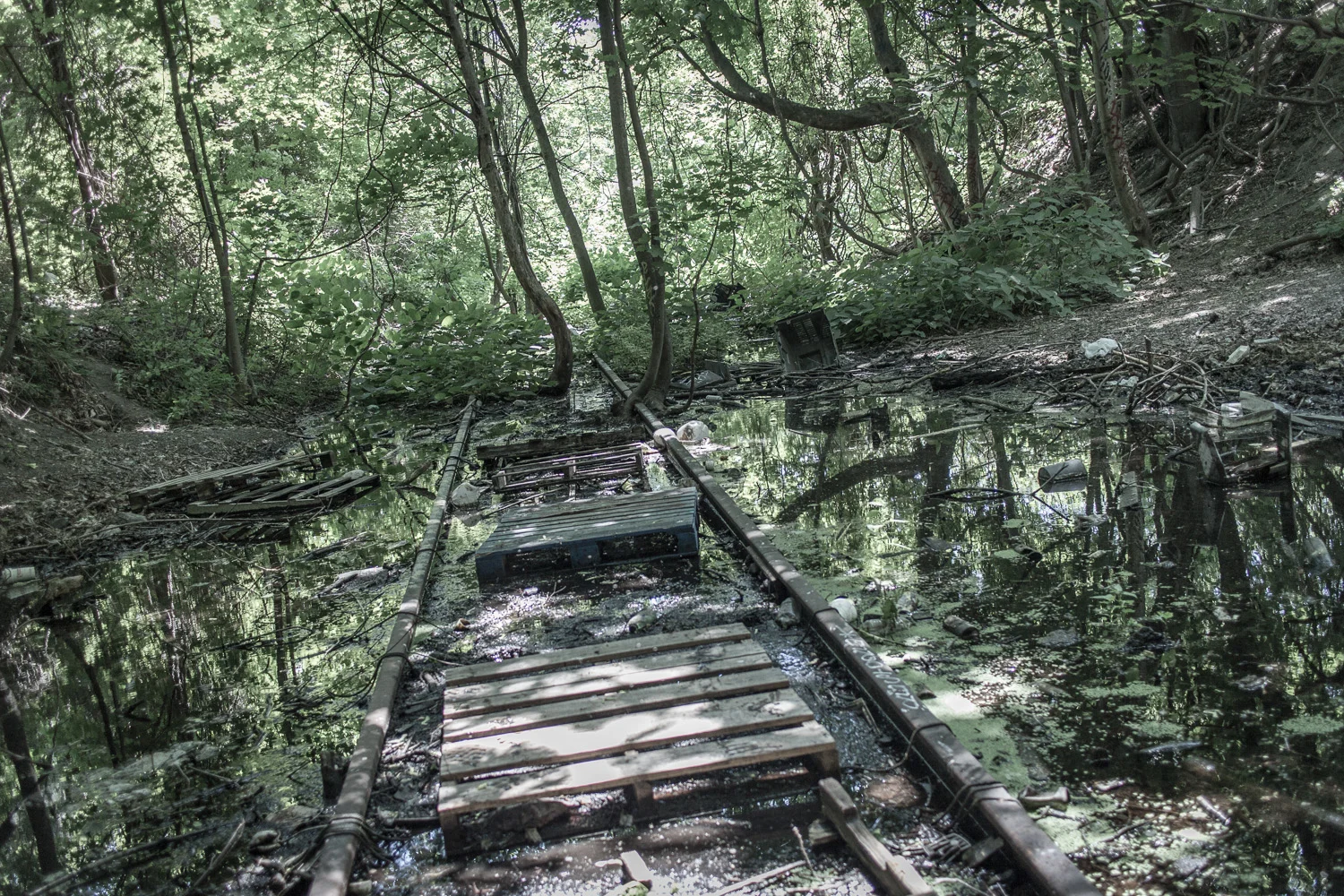
A few weeks ago I had the chance to walk the length (and record sound) of the former New Haven Railroad tunnel that lies beneath the historic streets of Providence's east side. It is a very interesting walking experience. The only entrance is from the east portal, just below Gano Street. There is a good amount of standing water there both outside the portal and within, probably close to a foot deep. The portals have been blocked up with steel panels but attempts to keep the tunnel totally closed are regularly thwarted, in fact it looks as though someone with a torch cut a small door in one side. Aside from what light comes through the door and the gaps in the steel it is very dark and very cool. Although it was built for two tracks only one remains and the roof is very high, probably to accommodate the electric catenary that once was strung above one of the tracks.
The water recedes some as you travel west, the ballasted road bed is mostly dry with small streams along both walls. The line is very straight, and only hooks near the western end. The walls are decorated with graffiti and there are the scattered remains of many adventures and parties, and the rusted hulk of one abandoned car. Near the western portal sunlight streams through gaps in the steel panels and again there is deep standing water on the tracks.
Water drips constantly and reverberates throughout the tunnel. There is a sulfur smell in the air and in places it seems very cave like with stalactites hanging from the roof and partnered stalagmites forming on the rail bed and in one spot on the top of the rail. There is no way out on the western side down below Benefit street so it's a there and back walk. The distance one way is a little more than a mile. Bring rubber boots and flashlights and don't go alone. It is state property and technically it is trespassing so take care.
A number of years ago I put this research together for an exhibition. East Side Monthly thought so much of it that they lifted it whole and published it without credit as part of a story they did on the tunnel, just in case it seems familiar.
The East Side railroad tunnel opened with much fanfare on November 15th, 1908. Tunnel laborers held a small demonstration and the story headlined that Sunday's Providence Journal. On that day the emperor of China died, Governor Higgins issued the annual Thanksgiving proclamation and a somber ceremony marking the closing of the Fox Point railroad station followed the last "transfer car" downtown. The Fox Point station had served the city for 73 years but had been made obsolete by the tunnel which would bring trains directly in to Union Station on Exchange Terrace.
The tunnel project had begun two years before, on the 20th of April, 1906. Also on that day a streetcar jumped track on Plainfield Street and a massive fire following an earthquake destroyed most of the city of San Francisco. Crews working east from Benefit Street. and west from Gano Street met below Cooke Street on April 7, 1908, a day earlier than expected. The night shift of the westerly section won the honors for digging the farthest in one shift, and every one was given the next day off. On that day the New York Conference of Methodists rescinded a long standing ban on dancing.
Originally the tunnel had two tracks, one of which was electrified, as the line to Bristol and Fall River was served by electric interurban cars until 1934. The tunnel also provided a route to Boston for trains that did not need to stop at Pawtucket. Traffic patterns changed, the second track was removed in the 1950's and the tunnel became a route for freight trains only. The line to Bristol was abandoned in 1976. In 1981 ownership of the tunnel itself was transferred to the State of Rhode Island and the last train traveled through it shortly after that. No ceremony was noted.
On May 1st. 1993, a group of students gathered at the western portal below Benefit Street for a May Day party. They lit fires, put on animal masks, pounded on drums until early the next morning, when police arrived. Fearing the activities in the tunnel were unsafe, they attempted to get the students to leave. The situation escalated quickly as some students refused to go, the police responded with pepper spray and the students answered with rocks and bricks. The ensuing melee ended with many injuries and a badly damaged police car, and the police charge in the next day's paper that they had encountered "satanic rituals". As a result the portals on both ends were sealed up with steel doors, which soon were forced open.
Other items:
The Benefit St. Armory was moved to its present location to make way for the tunnel. The building was leased by the state to the Providence Marine Corps of Artillery, an organized military company, for a term of one thousand years from June 23, 1852, at a yearly rental of six and a quarter cents. The military company wished to maintain this lease arrangement rather than have a new building built, so the New Haven Railroad made the necessary land purchases and moved the armory building with mule teams and logs.
The cost of the project, which included the bridge over the Seekonk river and the approach to Union station was two million dollars. No casualties were reported during construction. The area surrounding the west portal, the scene of the "student riot" is now a parking lot.
Chimi Trucks on Broad Street
Photographs by Erik Gould, Adrienne Adeyemi and Sothdra Nguon-Devereaux
Audio recordings by Adrienne and Sothdra, audio montage edited by Erik
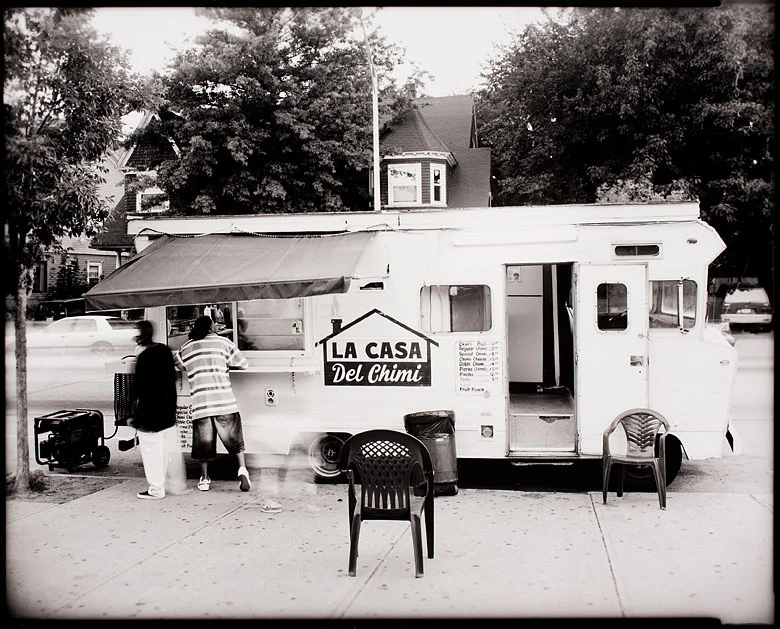
This photo essay is a collaboration of sorts between myself and two students I worked with while as a mentor at New Urban Arts, an arts based after school program for Providence high school students. Both Sothdra and Adrienne had assisted me on a project I did in partnership with NUA called the Providence Project. This was a neighborhood by neighborhood photo survey of Providence. We talked many times of going to take pictures of the Broad Street food trucks but during the time of the Providence Project we never did it. I so enjoyed doing photography with the two of them that during the summer before they both went on to pursue college careers we did a number of photo outings. Jesse Banks, studio manager at NUA, good friend and NUA alum also joined in. This trip to Broad Street was one of those outings.
On beautiful Providence July evening Jesse, Adrienne, Sothdra and I set out for Broad Street on Providence's South side to visit the Chimi trucks that set up there nightly. These mobile food vendors park along a stretch of Broad Street from Trinity Square to the Cranston line. I have long had an interest in these food trucks, they seem emblematic to me of new Americans making their way in business, working with what they know and what they have, free of corporate franchises. As a photographer I'm always on the look out for the hand-painted sign and the owner-operated business, that's where you the best stuff. We found a lively energy around these trucks and in the various shops up and down the street. People gathered to talk and hang out, guys with flashy cars would come by to show off. Music came from all over.
We talked about the contrast between that energy and the more subdued atmosphere we found in some other city neighborhoods we had photographed, which are really just a few blocks away. That is something else that I notice about Providence: Providence people keep to their own neighborhoods and they often don't know much of what's happening a few streets away. The Chimi truck scene couldn't be more public but I think many people who live in other neighborhoods would have no idea what I mean if I asked "what do you know about La Casa Del Chimi?" Well, I'm no Chimi expert either so that's why we went over to check it out. As for the Chimi sandwich itself, just like the hot dogs at the ballpark, all food tastes better when eaten out of doors on a summer night.
This piece is also an example of another idea: looking at one scene or one event from multiple points of view and with different recording media. Here we have 4 photographers, one with a big 8x10 camera on a tripod, the other's with more mobile cameras and digital audio recordings. These different sources reflect our individual points of view and also explore the ways that different materials produce different renditions of seemingly the same subject. This aspect of documenting the documentation and looking at how the actions of recording can change the event is something I have often examined and is central to much of my recent work. The 8x10 camera always attracts attention and Sothdra and Adrienne quickly became pros and dealing with interested onlookers while I got my pictures. Recording digital audio was originally Adrienne's idea and came out of many such experiences we had with passers by and the humorous, interesting and sometimes crazy remarks we would often get. The audio here captures street noise, conversation, music, and the steady roar of the Chimi truck generators. Inexplicably it also includes me saying the name "Pee Wee Herman." Have a listen.
Listen to the Pictures Part 2
Parts 1-4 of the audio piece created from field recordings made during the walks along the Moshassuck River. Recordings were made over a period of about 9 months.
Listen to the pictures: Conanicus' Bow audio
The full audio will be available on Saturday when the show opens.
Talking Back

Ever want to talk back at work?
So the economy pretty much sucks right now, maybe you have a job, or maybe you are looking for one, or maybe your hours have been cut, but we all have work to do. Sometimes it’s work with a capital “W”. Sometimes it’s just a dirty job and someone has to do it.
As part of a project looking at the impact of the Great Recession (or whatever this is) I am talking to people, all sorts of people about their jobs and their work.
What does work mean you? What do you think about on the job? What would you say to your job if you could?
I’m currently collecting audio interviews and taking pictures, and I would love to talk to you, dear reader. If you are interested, get in touch... OR if you can:
Stop by my booth at the indiearts fest, Providence RI, July 31.
12 noon to 8:00 PM. info: http://indieartsfest.com/
Hope to see you there!
Background music by AREA C.