Cold Coffee
never breaking news.
Field Notes: Photographing what's not there.
Making the photographs for the 2015 Most Endangered Properities show.
Former site of Fruit Hill School. 2015
Now that the Most Endangered Properties 20th Anniversary Photography Exhibit is now open I can share my contribution and how it was done. This year I took on the task of photographing three sites where the endangered property could not be saved. These are the former sites of the Grove Street school, Fruit Hill school and Providence Fruit and Produce warehouse. Two locations are currently empty lots and the third has some new commercial development. A full history of each site can be found here.
Former site of Grove Street school. 2015
Former site of Fruit and Produce Warehouse. 2015
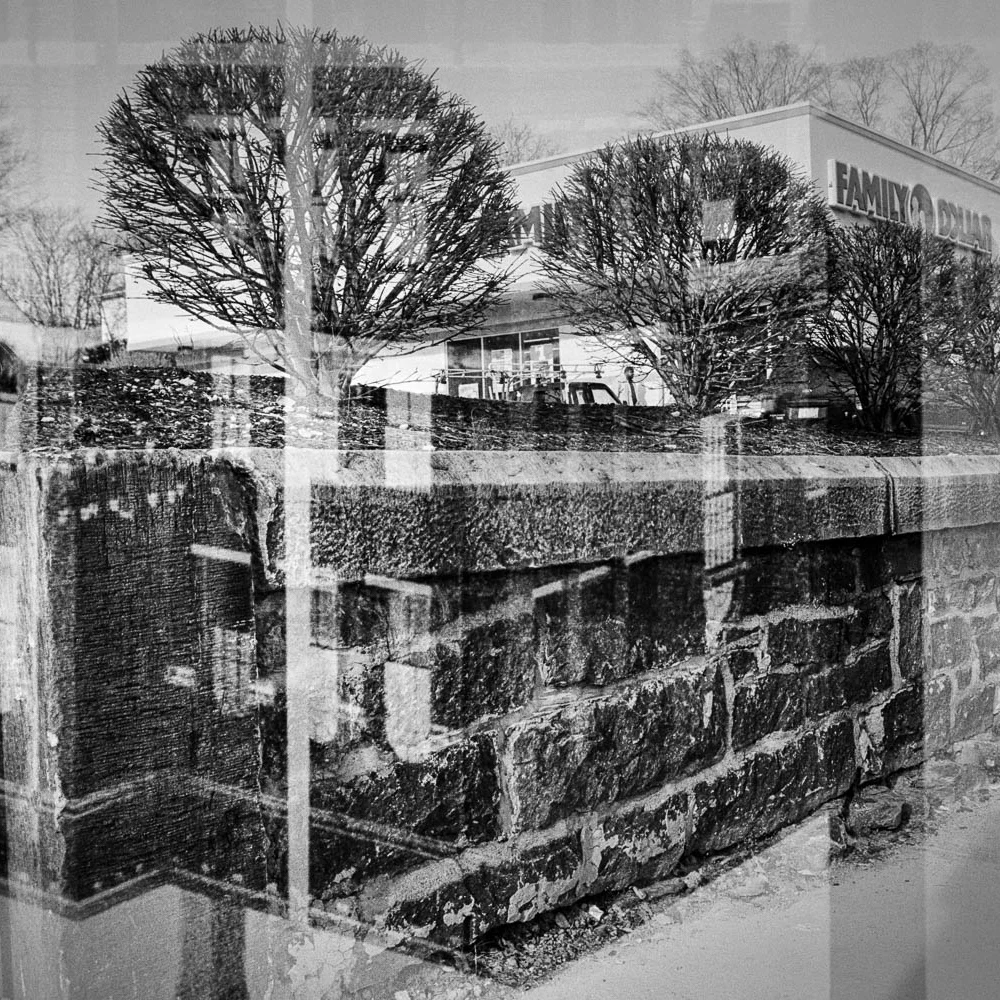
I took an approach with these locations to layer the current state with what was lost using in camera montage. Each space was photographed on a roll (two rolls) of 35mm film. I chose not to go with just one set point of view, rather I walked the site and recorded what saw and what interested me as I explored the space. I moved from wide views to details, looking for good coverage and nice juxtapositions. The film was then rewound, leaving just the leader exposed and identified by site.
Back in the studio I set up for basic copy photography, mounting the camera on a vertical stand and swapping in a macro lens. I had previously collected vintage images of each site, in the case of the Produce Warehouse I used my own images from the 1990s. I used archive images of the two schools including some vintage postcards. On each site I had about a half dozen different archival images to choose from. I used 5x7 prints of each. I then reloaded the film and cycled through the various images, sometimes altering cropping and exposure.
I then crossed my fingers and processed the film in the darkroom. I easily could have done this digitally but one of the wonderful aspects of shooting film is to open your work up to an element of chance. I always look for ways that I can introduce the "happy accident" or employ a chance operation. There is risk, but in risk their can be reward. Happily I felt I was rewarded here.

HARRY CALLAHAN Providence, ca. 1966 (Shepards)
Astute photo history people no doubt notice that I was inspired in this by the work of the master photographer Harry Callahan. In the 1960s during his tenure as the head of the photo program at RISD he did an amazing series of in camera montages, photographing, most appropriately. in downtown Providence among other places. The image above features the storefront windows of Shepards department store. The Shepards building was one of the very first properties on the MEP list and happily has been saved.
As I was working on deadline, I hedged my bets and shot each site in a more conventional way. It never hurts to have a backup plan. These were also shot on film, this time on 120 format using a Graflex SLR. This type of camera lends itself to a low point of view which seemed appropriate to me for these vacant sites, especially the former school locations.
Former site of Fruit and Produce Warehouse. 2015
Former site of Fruit Hill School. 2015
Former site of Grove Street school. 2015
Providence Fruit and Produce Warehouse
This post first appeared on the Endangered Places, Emerging Stories blog of the Providence Preservation Society. The post can be found here, along with other interesting pieces on buildings lost, saved and on the bubble in Providence.
Harris Avenue was one of the very first places I would explore in Providence shortly after I arrived in 1992. I can clearly recall the first trip out with the 4x5 camera to that part of town. A spring afternoon, Sunday, the sun clear and warm. Red brick, dusty streets and not a soul around. The area felt ignored and forgotten, as if time had slowed to a crawl. Activity ceased or barely persisting in the evidence of one or two boxcar loads on a siding and a scattering of trucks at a few loading docks. Perfect for me and my slow camera. Plenty of time and none. For if there had been little change over the previous 25 years on Harris Ave. the next 25 would be otherwise.

There were several structures of interest that together made up the fabric of the district, held together by railroad tracks and the river channel. An ivy covered signal tower from the New Haven railroad era, a single story track side warehouse with a curving wooden dock, the hulking Providence Cold Storage warehouse, and the iconic Silver Top diner.
Anchoring the street was the concrete art deco of the Providence Fruit and Produce Warehouse. Long (almost 900 feet) and low it was built in 1929 when rail was king to hold produce unloaded from boxcars for distribution through the city. In 1992 there was some activity but it was hardly a bustling place. One by one these places were pulled from the fabric, torn down or in the case of the Silver Top, moved. The space itself was intruded upon by new highway off ramps.
When the warehouse was finally pulled down in 2008 I wrote this: ...[the warehouse] has great value because it connects us to our past, it is real in a way that buildings like the Providence Place Mall will never be. This is our heritage, built for an honest hard working purpose, not a sham echo of something it is not. This is not a decorated box, which is almost surely what we will get in the place of the warehouse." The rest of this rather angry blog post can be found here.
February 2008
So far all we get in place of what might have been is an empty lot. Perhaps it could have become the year round farmers market that Providence so desperately needs. Perhaps not. Although tons of produce still moves by rail it is not the fruit and veg that the new farm to table trade is built on. Perhaps it could have been arts space. We'll never know. Looking at these pictures reminds me that the only time we have is now, and if we wish to maintain a connection to the past we have to work at it, or all that will remain is a photograph. That said, you can view more photographs here.